Oct 14, 2026
Best Peec AI Alternatives for Tracking AI Visibility in 2026
Your brand's AI visibility is not a future concern. It is a current revenue leak. When your product is referenced in a ChatGPT answer

Introduction
Your brand's AI visibility is not a future concern. It is a current revenue leak. When your product is referenced in a ChatGPT answer, that mention can redirect purchase intent before a user ever opens a search engine. Ignore this channel, and you forfeit discovery.
By 2026, 44% of US adults use ChatGPT, and the platform has surpassed 800 million weekly active users. This audience shift coincides with a brutal traffic compression on traditional search. Ahrefs data reveals AI Overviews correlate with a 58% lower click-through rate for even the top organic result. You are losing measurable referral traffic that conventional rank trackers cannot see.
Peec AI emerged as a competitive benchmarking tool for this new landscape, monitoring brand mentions across ChatGPT, Perplexity, and Gemini. However, its opaque pricing prevents budget forecasting, and its engine coverage excludes major platforms where buyers research, including Claude and Microsoft Copilot. A tool that leaves those gaps forces you to guess about a significant slice of your AI-driven brand exposure.
This article examines the top Peec AI alternatives across budget, engine coverage, and specialization. You will find a direct comparison of Siftly, Otterly.ai, and Scrunch, each optimized for a distinct use case: e-commerce product monitoring, affordable brand tracking, and enterprise multi-engine intelligence.
Key Takeaways
- AI search has matured faster than most monitoring tools. ChatGPT alone has passed 800 million weekly active users, compressing traditional organic click-through rates by 58 percent according to recent research. Picking a platform gets expensive and complicated fast.
- Peec AI leaves gaps in Claude, Microsoft Copilot, and Grok coverage. It also hides its pricing behind a sales call, which slows evaluation for teams that need to move quickly. Your alternative should close those engine gaps without adding weeks of negotiation.
- Siftly is the logical swap for e-commerce teams. It connects catalog health directly to AI visibility and monitors product-level citations, a capability no other tool replicates. 15 to 20% of Referral Traffic Now Comes from AI Chat. For a lot of stores, that channel already outpaces email.
- A small marketing team can get started with Otterly.ai at $29 per month. It covers six engines and is the lowest entry price in the category. If you need broader coverage and an API, Scrunch monitors seven engines (Claude and Meta AI included) at $250 per month billed annually.
- The rest of this guide walks through six alternatives, what each one actually monitors, and the pricing (or pricing opacity) every buyer hits when they evaluate Peec AI.
Verdict: The Best Peec AI Alternatives at a Glance
No single alternative replaces Peec AI for every team. Your choice depends entirely on whether you need product-level citation data, broad multi-engine coverage, or an accessible price point. The tools below each solve a specific version of the AI visibility problem that Peec AI leaves open.
- Otterly.ai is the default for small marketing teams who need to prove value before scaling. At $29 per month, it provides transparent, prompt-level monitoring without requiring a demo call. It covers six engines: ChatGPT, Perplexity, Google AI Overviews, Google AI Mode, Gemini, and Microsoft Copilot. The trade-off is depth: you get brand mention tracking, but not the competitive benchmarking granularity or citation-attribution records that larger platforms offer.
- Siftly owns the e-commerce niche. It tracks how AI engines describe your products and whether those descriptions cite your catalog pages accurately. By connecting a Shopify store, Siftly ties AI citation data to catalog health, surfacing product-level visibility gaps. Its multi-engine AI competitor benchmarking dashboard lets you compare mention rates and citation quality across ChatGPT, Gemini, Perplexity, and AI Overviews. The Starter plan tracks 3 products, and a free audit with no sign-up makes testing possible without commitment.
- Scrunch is the enterprise answer. Covering ChatGPT, Perplexity, Gemini, Claude, Microsoft Copilot, Grok, and Meta AI, it delivers the broadest engine footprint available. The $250-per-month annual plan includes API access and competitive benchmarking. For organizations where a missed Claude citation represents a measurable revenue risk, the seven-engine coverage justifies the investment.
Comparison Table: Peec AI vs. Top AI Visibility Tracking Tools
The table below maps the four platforms across the dimensions that matter most in a buying decision: engine coverage, pricing transparency, starting cost, e-commerce depth, and target user.
| Dimension | Peec AI | Siftly | Otterly.ai | Scrunch |
|---|---|---|---|---|
| Engines Covered | ChatGPT, Perplexity, Gemini, plus 7+ additional LLMs as of mid-2026 | ChatGPT, Claude, Perplexity, Gemini, AI Overviews | ChatGPT, Perplexity, AI Overviews, AI Mode, Gemini, Copilot (6 total) | ChatGPT, Perplexity, Gemini, Claude, Copilot, Grok, Meta AI (7 total) |
| Key Features | Competitive benchmarking, brand mention tracking, real-time monitoring | Product-level citation tracking, catalog health integration, AI crawler traffic, competitor benchmarking | Prompt-level brand monitoring, reporting dashboards, six-engine coverage | Multi-engine competitive benchmarking, API access, enterprise reporting |
| Pricing Transparency | Opaque (no public pricing) | Public pricing; free audit available with no sign-up | Public pricing; starts at $29/month | Public pricing; starts at $250/month (billed annually) |
| Starting Price | Unlisted | Self-service plan available; Starter tracks 3 products | $29/month | $250/month (annual billing) |
| E-Commerce Support | None | Shopify integration, product-level monitoring, catalog health tie-in | None | None |
| Target User | Brands needing competitive AI benchmarking with a sales-assisted buying process | E-commerce product and marketing teams monitoring product citations | Small teams and SMBs needing affordable multi-engine brand tracking | Enterprises requiring broad engine coverage, API access, and deep benchmarking |
Peec AI is the only tool on this list that hides its pricing entirely. You sit through a demo before you see a number. Siftly and Otterly.ai both post transparent pricing; Siftly even offers a free audit with no sign-up. Scrunch publishes its annual rate of $250/month but that puts it out of reach for most small teams.
Siftly's e-commerce depth separates it from the pack. It connects to Shopify, tracks product-level citations, and ties those citations back to catalog health. The other three tools treat e-commerce as an afterthought. Peec AI and Otterly.ai skip it entirely, while Scrunch aims at enterprise benchmarking that doesn't drill down to individual SKUs. A direct-to-consumer brand watching what ChatGPT says about its bestseller will hit a wall on any platform except Siftly.
Engine coverage looks comparable on paper. Peec AI tracks 10+ LLMs, Scrunch covers 7, and Otterly.ai monitors 6. Those raw counts matter less than most buyers assume. A tool that covers 10 engines but can't tell you which one drove a product citation gives you breadth with no action behind it. Siftly ties the engine data to something concrete: the product pages that actually benefit from the mention.
Siftly: Product-Level AI Visibility and Catalog Health for E-Commerce
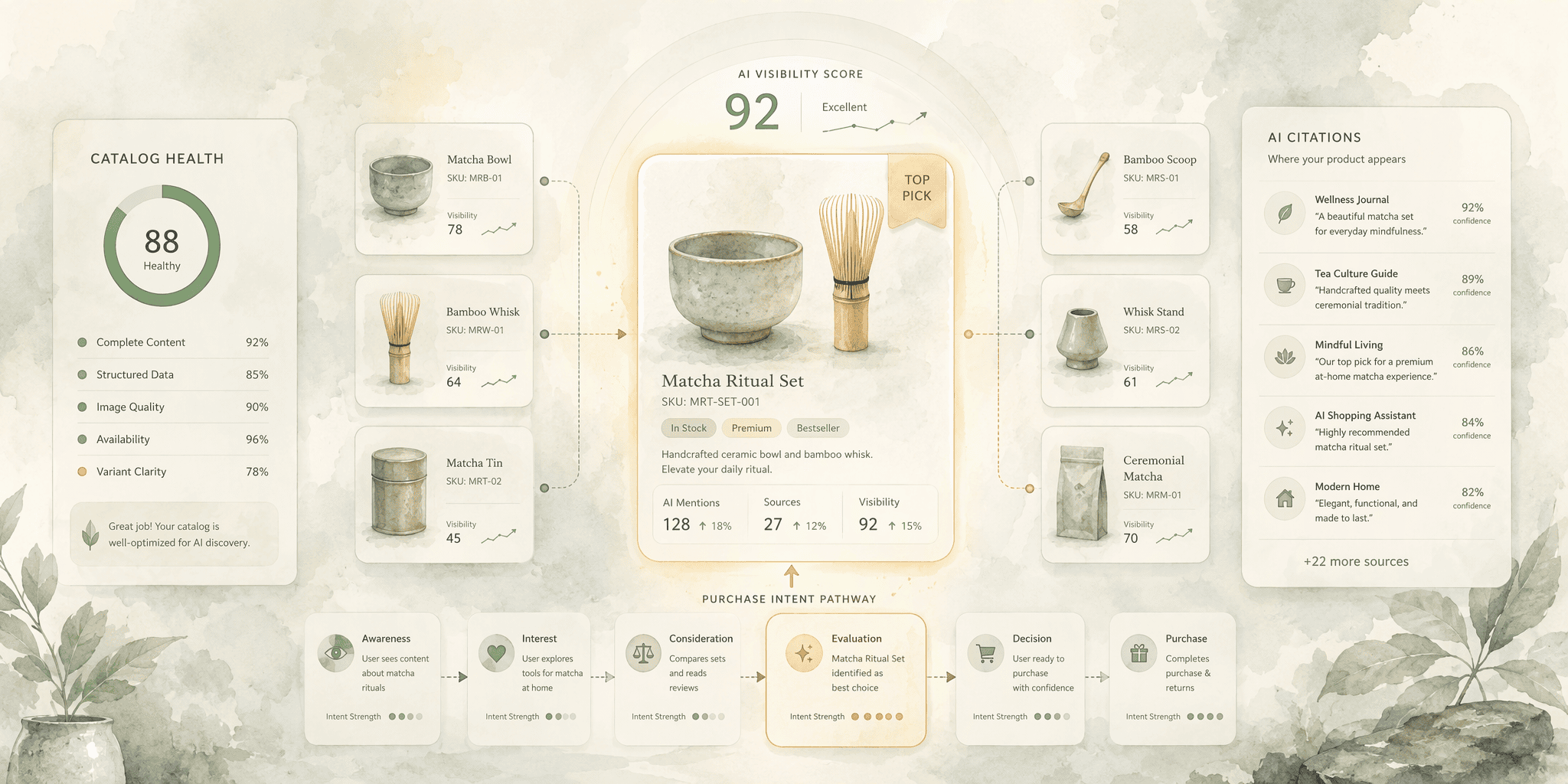
Most AI visibility tools treat your brand as a single entity. Siftly breaks it down to the product SKU level, tracking which items AI engines cite, how accurately they describe them, and whether those citations drive purchase intent. This granularity matters because an AI answer recommending a specific product type creates conversion opportunity that brand-level monitoring misses entirely.
Siftly connects directly to your Shopify store, aligning AI citation data with catalog health. When a product page changes, Siftly's platform measures whether AI engine descriptions update accordingly. Its multi-engine coverage spans ChatGPT, Claude, Perplexity, Gemini, and Google AI Overviews.
The competitive benchmarking dashboard surfaces how frequently competitors' products appear for the same buyer queries. A free audit requires no sign-up, and the Starter plan tracks 3 products, making it practical for product teams to test the value of AI citation monitoring without a heavy upfront commitment. The platform also attributes referral traffic directly to LLM citations, closing the loop from visibility measurement to traffic impact.
Otterly.ai: Accessible AI Brand Monitoring for Small Teams
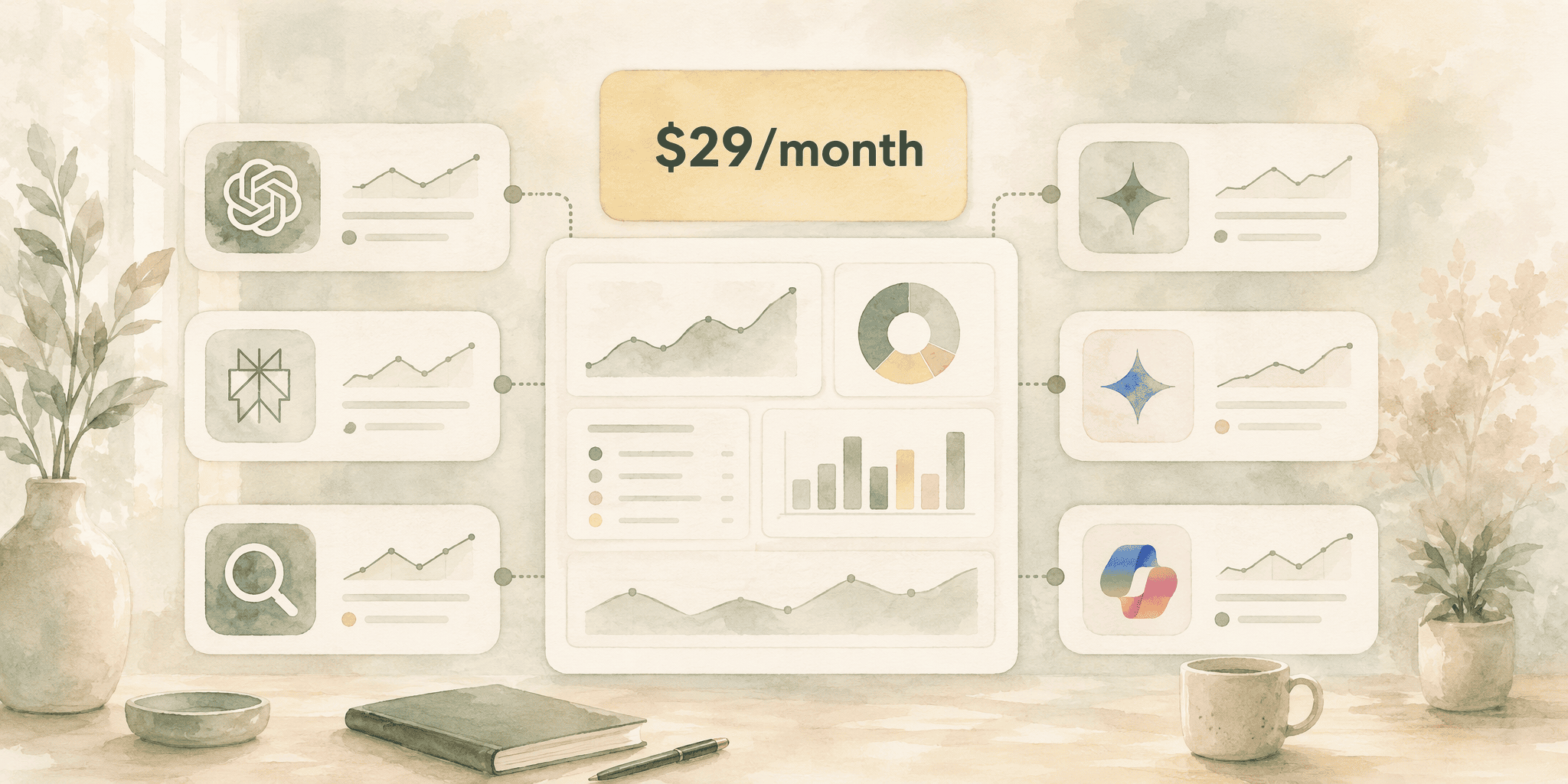
Otterly.ai strips AI visibility tracking down to a transparent, predictable cost: $29 per month for monitoring across six engines. That coverage includes ChatGPT, Perplexity, Google AI Overviews, Google AI Mode, Gemini, and Microsoft Copilot. For a small marketing team, this is the lowest-friction path to understanding whether your brand appears in generative answers without sitting through an enterprise sales call.
What you sacrifice is competitive benchmarking depth. Otterly.ai shows you where your brand shows up, but does not surface a competitor's share of voice for the same prompts. For teams that need only a directional visibility baseline, that limitation is acceptable.
Scrunch AI: Broad Engine Coverage and Enterprise Reach

Scrunch covers seven engines: ChatGPT, Perplexity, Gemini, Claude, Microsoft Copilot, Grok, and Meta AI. This footprint matters because the same buyer who asks Copilot at work often opens ChatGPT or Perplexity at home. Five engines is a reasonable floor for data that reflects how buyers actually research, and Scrunch exceeds that threshold by a comfortable margin.
At $250 per month billed annually, Scrunch positions itself squarely for organizations where AI visibility is a line item in the brand intelligence budget, not an experimental spend. The platform includes API access, which lets engineering teams build custom monitoring dashboards and feed AI citation data into existing business intelligence workflows. Competitive benchmarking operates across all seven engines, so you can measure share of voice differentials between your brand and specific competitors inside Claude-generated answers just as easily as inside ChatGPT.
Claude and Copilot coverage separates Scrunch from both Peec AI and lower-cost alternatives. For enterprise brands in regulated industries where Claude's analytical positioning carries disproportionate influence on B2B buyers, this differentiation alone can justify the cost. A financial services brand that appears in ChatGPT but is absent from Claude is invisible to a meaningful segment of its audience.
Scrunch deploys as infrastructure, not just a dashboard. The API layer means your analytics team can pipe AI citation data into existing attribution models, even if the citations-to-revenue connection remains directional rather than fully validated. For organizations large enough to dedicate headcount to generative engine optimization, this flexibility matters more than a slightly lower price point.
Peec AI: Competitive Benchmarking with Limited Pricing Transparency

Peec AI built its reputation on competitive benchmarking. It tracks how often your brand appears in generative answers relative to specific competitors, across ChatGPT, Perplexity, and Gemini. A mid-2026 expansion added Mistral coverage, bringing the platform to 10-plus LLMs tracked globally, a signal of ongoing investment.
However, Peec AI's pricing remains opaque. No public plan costs exist, which means every prospective buyer must enter a sales conversation to budget the tool. For a small or mid-market team, that friction alone pushes the evaluation toward alternatives with clear, listed pricing like Otterly.ai or Scrunch. Without a listed starting point, you cannot benchmark Peec AI's cost against the value it delivers before engaging a sales representative.
Engine coverage continues to be the most substantive limitation. Peec AI does not monitor Claude, Microsoft Copilot, or Grok. A 2025 analysis of more than 118,000 AI answers found ChatGPT cites roughly 8 sources per answer and Perplexity around 22, but those statistics only matter if you can see which sources those engines cite. A tool that cannot report on Claude or Copilot leaves a contested share of the generative landscape unobserved.
For a brand whose primary AI visibility concern is benchmarking against a known competitor set inside ChatGPT and Perplexity, Peec AI remains functional. Its real-time monitoring and competitive positioning features are strong enough. The issue is not capability; it is cost predictability and coverage breadth. As soon as you need Claude visibility, or as soon as you need to forecast the tool's annual cost against other line items, you will bump against Peec AI's structural limits.
Which AI Visibility Tool Should You Choose?
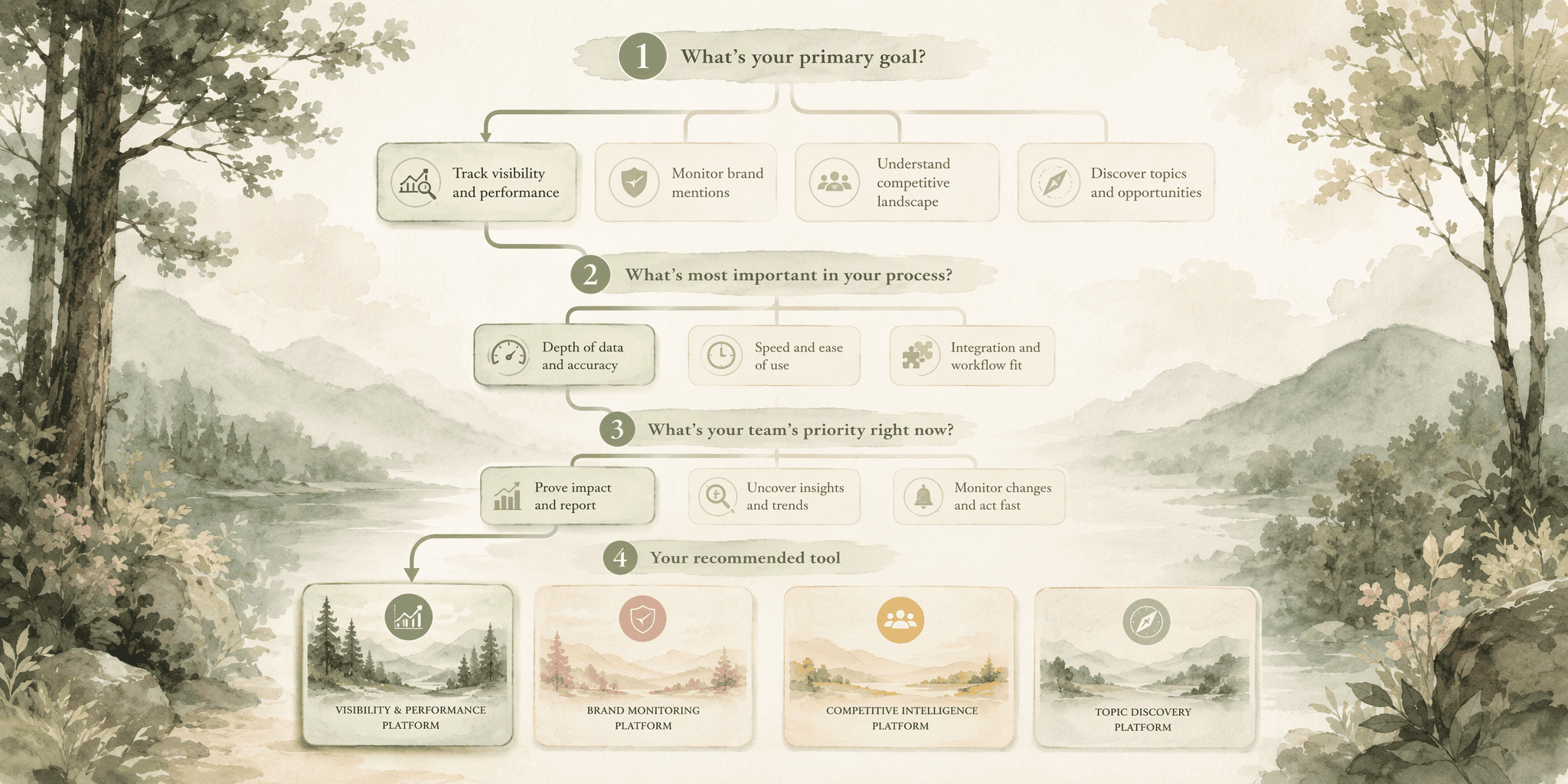
Your decision should follow your business model and the granularity of visibility data you need. Use this framework to narrow the field before starting any trial.
- E-Commerce Product Teams: If you sell physical or digital products and need to know which SKUs AI engines cite, choose Siftly. Its Shopify connection ties catalog health to AI citation data, and the free audit requires no sign-up, so you can test product-level visibility without commitment.
- Small Businesses and Budget-Constrained Teams: If you need six-engine brand monitoring at the lowest available price, Otterly.ai launches at $29 per month with transparent, prompt-level tracking. You will not get deep competitive benchmarking, but you will get a clear visibility baseline.
- Enterprise Organizations Needing Multi-Engine Coverage: If your brand requires Claude, Copilot, and Meta AI visibility alongside ChatGPT and Gemini, Scrunch covers all seven engines at $250 per month billed annually, with an API layer for integration into existing analytics infrastructure.
- Competitive Benchmarking Only: If your primary need is comparing your brand's mention rate against competitors inside ChatGPT and Gemini, and you can tolerate an opaque pricing process, Peec AI may still fit. Verify engine coverage before committing, given the Claude and Copilot gaps.
Conclusion
Peec AI handles competitive benchmarking well. Opaque pricing and narrow engine coverage keep it from being the obvious default. Other tools solve those gaps directly.
ChatGPT sees 800 million weekly users. Traditional search click-through rates have compressed by 58 percent. That channel is too large to ignore.
Define your business model and the coverage you need. Pick the tool that maps to it. Test with a free trial or an audit before you commit budget.
Frequently Asked Questions
What is AI visibility tracking and why does it matter for brands in 2026?
AI visibility tracking monitors how often and in what context brands appear in generative AI answers from engines like ChatGPT, Gemini, and Perplexity. By 2026, 44 percent of US adults use ChatGPT, and AI Overviews correlate with a 58 percent lower click-through rate on top organic results. Brands without visibility data lose discovery traffic.
How does Peec AI work for monitoring brand presence in AI search engines?
Peec AI tracks brand mentions across ChatGPT, Perplexity, and Gemini, with real-time monitoring and competitive benchmarking that shows how often you appear relative to specific competitors. Its pricing is not publicly listed, and engine coverage excludes Claude, Copilot, and Grok.
What are the top alternatives to Peec AI for tracking AI visibility across ChatGPT, Gemini, Perplexity, and AI Overviews?
Siftly specializes in product-level e-commerce AI visibility with Shopify integration. Otterly.ai covers six engines starting at $29 per month, ideal for small teams. Scrunch covers seven engines including Claude and Copilot at $250 per month for enterprise needs.
How do Peec AI alternatives compare on features like competitive benchmarking and pricing?
Scrunch offers the broadest competitive benchmarking across seven engines with public $250 monthly pricing. Peec AI provides strong benchmarking but opaque pricing. Otterly.ai keeps tracking simple at $29 monthly with limited benchmarking. Siftly benchmarks at the product level for e-commerce.
What should I look for when choosing a tool to monitor and improve my brand's generative engine optimization?
Evaluate engine coverage first. Tools covering Claude and Copilot capture more buyer research behavior. Next, assess citation depth. A GEO tool that does not surface which specific URLs AI engines cite leaves critical data on the table. Match pricing transparency and use-case specialization to your team's needs.
- Engine coverage: Tools covering Claude and Copilot capture more buyer research behavior.
- Citation depth: A GEO tool that does not surface which specific URLs AI engines cite leaves critical data on the table.
- Pricing and specialization: Match pricing transparency and use-case specialization to your team's needs.
How can I test an AI visibility platform for free before committing to a paid plan?
Several tools offer no-cost entry points.
- Siftly provides a free AI Visibility Checker with no sign-up required.
- Otterly.ai lists a $29 monthly plan that can serve as a low-cost trial.
- Request a demo from Scrunch and confirm trial availability during the sales process.
Sources
- Siftly · Win in AI Search — ChatGPT, Claude, Perplexity & AI Overviews - siftly.ai
- 15-20% of Referral Traffic Now Comes from AI Chat. - siftly.ai
- Peec AI Pricing: Plans, Costs & Extra Fees (2026 Guide) - www.workduo.ai
- Top AI Visibility Tracker Tools in 2026 - kime.ai
- Best Generative Engine Optimization tools - Cognizo - www.cognizo.ai
- Best AI Visibility Tools 2026: An Honest, Side-by-Side Comparison - withmaya.ai
Keep exploring
More from the blog.

Oct 29, 2026
How to Track If Competitors Appear More Than You in AI Search Results
Your closest competitor just got a glowing recommendation. The prospect never visited a review site, never searched your brand

Oct 29, 2026
How to Track Whether Competitors Appear More Often Than You in AI Search Results
Traditional rank-checking is dead. When a prospective buyer asks ChatGPT or Perplexity a purchase question

Oct 28, 2026
7 Best Answer Engine Optimization Tools for Dominating AI Citations in 2026
You have spent months getting a page into the top three organic spots for a major keyword. The content is well optimized. Backlinks are solid.