Oct 29, 2026
How to Track Whether Competitors Appear More Often Than You in AI Search Results
Traditional rank-checking is dead. When a prospective buyer asks ChatGPT or Perplexity a purchase question

Introduction
Traditional rank-checking is dead. When a prospective buyer asks ChatGPT or Perplexity a purchase question, the answer does not produce the ten blue links you have optimized against for two decades. It generates a paragraph with maybe four or five cited sources buried inside the prose. If your competitor is cited there and you are not, the keyword ranking on your legacy search dashboard is irrelevant.
Generative engines remove the need to navigate to websites by directly providing a precise and thorough response, which means the battleground has shifted from the search engine results page to the answer itself. Visibility is no longer about organic position. It is about citation frequency, position within the response, and the context surrounding each mention. The 2023 Princeton GEO framework led by Aggarwal et al. formalized this new reality, defining generative engine optimization as a black-box framework for measuring visibility across multiple dimensions including objective relevance and subjective influence.
Quantifying whether a competitor is being referenced more often than your brand was nearly impossible two years ago. In 2026, a new category of monitoring platforms has matured to automate exactly that. This guide provides a seven-step methodology for building a continuous competitive AI citation monitoring operation. You will move from guessing about AI brand visibility to measuring it with the same rigor you apply to traditional paid and organic channels.
Key Takeaways
AI search visibility is measurable. You can track which sources generative engines cite, how often they cite them, and where in the answer those citations appear.
- Citation metrics replace rank position: Citation frequency, position within the AI-generated answer, and the length and context of each mention are the core visibility indicators that matter now.
- Automated monitoring is operational in 2026: Platforms from Brandwatch, Semrush, and BrightEdge now track brand and competitor citations across ChatGPT, Google AI Overviews, Perplexity, Gemini, and Claude.
- Content structure directly drives citeability: The Princeton GEO research found that including citations, quotations, and statistics boosted source visibility by up to 40% across diverse query types.
- Benchmarking quantifies your competitive position: Aggregating citation data into a per-domain share of voice percentage, segmented by engine and query category, answers the single question executives ask first: are we winning or losing?
- You need a directional traffic model: No platform today offers a fully validated citations-to-revenue attribution model, but you can correlate citation volume with branded search lift to justify investment.
Step 1: Redefine 'Top Position' for AI-Generated Search Results

A top position in AI search means being the first cited source inside the generated paragraph, not occupying a ranked slot on a results page. The old logic collapses when the AI model extracts and synthesizes information directly, presenting citations inline or as footnotes embedded within a narrative answer. Your content does not need to rank. It needs to be quotable by the model the moment the response is assembled.
The GEO framework introduced flexible visibility metrics tailored specifically for generative engines, measuring visibility across dimensions such as relevance and influence of citation to query. This is a controlled reference, not a scored hyperlink. Being first matters, but being cited with dense, authoritative detail close to the query intent matters more. Ditch your position-tracker instincts. Citation order and contextual weight have replaced the URL listing.
Step 2: Identify the Right Metrics for AI Citation Visibility
Replace the rank tracker you currently use with a three-metric framework designed for generative answer environments. SEO taught us to watch a single number on a SERP. That number doesn't exist here.
The three metrics to operationalize are:
- Citation frequency: How often is your domain cited across a defined set of queries compared to your named competitors? Raw mention count is the baseline share-of-voice signal.
- Citation position within the response: Where does your citation appear relative to competitors in the generated answer block? Being the first source in the first paragraph carries disproportionate visibility weight.
- Citation length and context: How substantively is your brand cited? The model might drop your name in a footnote, or it might quote your data, attribute a product spec to you, or pull a claim directly from your page. Researchers at Princeton and Georgia Tech found that longer, information-rich citations correlate with higher model trust and greater reader influence. A passing mention does different work than a citation the model treats as evidence.
Step 3: Set Up Automated Monitoring Across ChatGPT, Perplexity, Google AI Overviews, Gemini, and Claude
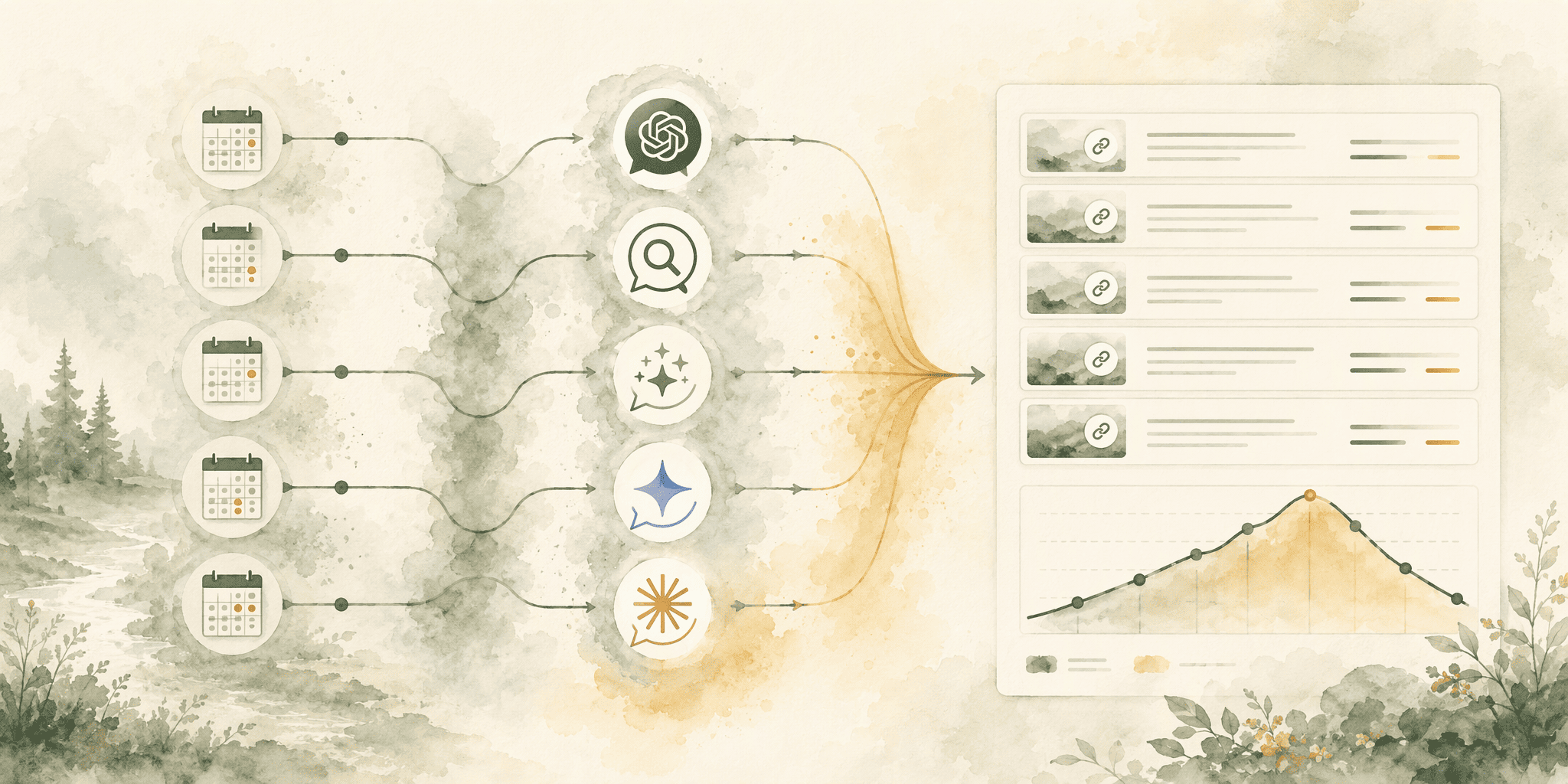
Manual tracking breaks down the moment you cross roughly 50 prompts per week against 5 competitors. You end up with fragmented spreadsheets, missed mentions, and citations you discover a week too late.
The 2026 competitive intelligence ecosystem now supports automated AI citation monitoring across the major generative engines. You can schedule queries, capture which URLs each engine cites for which prompts, and track how your visibility shifts day to day.
| Capability | Brandwatch | Semrush | BrightEdge | Siftly |
|---|---|---|---|---|
| Engines monitored | ChatGPT, Google AI Overviews, Perplexity | ChatGPT, Google AI Overviews, Perplexity | ChatGPT, Google AI Overviews, Perplexity | ChatGPT, Google AI Overviews, Gemini, Perplexity, Claude, plus four others |
| Citation tracking scope | Domain-level mention frequency and position | Domain and page-level citation reporting, competitive benchmarking | Enterprise-scale AI overview tracking with share-of-voice modules | Daily automated query execution with citation presence, competitor ranking, and AI visibility score |
| Competitive benchmarking | Yes | Yes | Yes | Yes, share of voice analysis and competitor product and price position tracking |
| Indicative monthly cost | $300 to $800 (mid-market tier) | $500 to $1,500 (varies by query volume and brands tracked) | Custom enterprise pricing | Seat-based pricing starting at $129/month; Scale tier at $599/month; Pro at $2,999/month |
| Distinctive capability | Broad social-to-AI listening convergence | Integrated with existing Semrush keyword and domain workflows | Enterprise-grade data depth and account-team delivery | Directional citation-to-traffic modeling and prescriptive GEO content recommendations |
Each of these platforms runs your prompt library on a schedule. You log in and see that ChatGPT cited your competitor's pricing page three times this week on a query where you used to hold the top spot. That is the signal you need, and it arrives before your quarterly brand-tracking report even notices.
Step 4: Perform a Competitor Citation Benchmark to Quantify Share of Voice

Turn raw citation feeds into a single answer your CMO needs: a share-of-voice percentage. Aggregate monitored data into per-domain citation share by dividing your brand'ss citation count by the total citations across all tracked competitors for a given query set. Segment this metric by AI engine.
ChatGPT, Perplexity, and Google AI Overviews each retrieve and cite sources through different retrieval pipelines. Query category segmentation matters equally. Your citation rate on product-spec questions may be zero while your thought-leadership citations are strong, and that blind spot costs you.
Plot share of voice as a trend line over time. Choose a weekly or monthly view across a rolling quarter. That line will tell you whether a competitor's content push is eroding your position before the revenue impact shows up anywhere else in the business.
Step 5: Analyze Citation Context and Content Structure with the GEO Framework

The raw citation count tells you what the engine included. The GEO framework helps you understand why a source earned its place. You look at three things:
- Citation style and placement: An inline citation woven into the sentence carries different weight than a footnote appended to the end of a paragraph. The Princeton researchers who developed GEO classify citations into these categories to reveal how the model integrated your source. An inline mention typically signals that the model used a discrete fact or statistic. A footnote-style reference often indicates broader topical relevance without a single extractable claim.
- Surrounding sentiment: Examine the immediate context around each citation. Is the surrounding text positive, neutral, or does it frame your brand as one option among many? The 2024 study published in the ACM Digital Library, "GEO: Generative Engine Optimization," examined 368 long-form queries and showed that the presence of citations alone did not predict user trust. When an answer cited authoritative domains but softened every claim with hedging language, readers discounted it.
- Quoted phrases from your content: Inspect what the model specifically quoted, paraphrased, or summarized. Pull the three to five content features the engine extracted the most from your domain. These are often how-to steps, numbered lists, direct statistics, definitions, or comparison points. This is the output a machine decided was quotable, so the form it takes gives you direct insight into what structure the engine prioritizes.
A domain might rack up ten citations while a competitor with three citations dominates the answer box. When that happens, the competitor's citations are often inline and paired with direct quotes, while the ten citations are footnote-style references the model treats as general background. The raw number misleads. The style and context reveal the real dynamic. Researchers in the Princeton study found that citation placement and surrounding sentiment together changed perceived answer credibility more than the total number of cited sources did. Reporting that load-in period without also capturing citation style and context gives you an incomplete picture of your visibility.
Step 6: Model Directional Citation-to-Traffic Impact for Your Business
AI engines do not pass clean referral data that ties a specific citation to a specific click. Every monitoring platform owns up to this gap. The page itself says no platform offers a fully validated citations-to-revenue attribution model. You need a proxy measurement that admits its limits but is rigorous enough to guide budget allocation.
The most practical method correlates changes in aggregated citation volume with movement in three signals: branded search traffic, direct site visits to pages cited by AI engines, and referral traffic from identifiable AI user agents where those headers survive.
Build a lightweight model in a spreadsheet. On one axis, plot weekly citation volume from your monitoring tool, segmented by top commercial-intent queries. On the other, plot search console impression and click data for your brand terms over the same period.
When citation share of voice rises 10 points, does branded search lift proportionally? The correlation is directional. A consistent, statistically meaningful relationship is enough to defend the program to a CFO.
Siftly and a few other platforms now ship directional citation-to-traffic modeling as a feature. You do not have to build it manually. The output surfaces the relationship between AI visibility and branded discovery demand with enough fidelity to make investment decisions defensible.
It is a model, not closed-loop revenue attribution. Run it monthly. Probabilistic model behavior and scores shift quickly as engines update.
Step 7: Operationalize Competitive Data to Improve Your Brand's AI Ranking

Competitive citation data is worthless unless it changes what your content team ships. The GEO framework surfaced structural attributes that repeatedly correlate with higher citeability: schema markup that helps models parse content predictably, direct quotations and named statistics pulled from authoritative external sources, and data-dense tables and definitional blocks that signal extractability.
Set a quarterly competitive recalibration cadence. Once per quarter, run the same citation benchmark across your target query set, segment the winners by content feature (did the top-cited competitor add structured data, publish new research, or restructure category pages?), and feed those findings into your editorial roadmap. The feedback loop is the moat.
Conclusion
Monitoring competitor visibility in AI search is a permanent operational function, not a quarterly audit you dispatch with an intern. The engines change retrieval and citation behavior on timelines measured in weeks. Your monitoring infrastructure needs to match that cadence.
Continuous measurement across frequency, position, and context builds the dataset that lets you optimize, defend budget, and catch competitive threats before they materialize in pipeline reports. The benchmarking standards for AI search maturity are being built right now across the tools and frameworks outlined here. Getting the infrastructure in place today puts your brand inside the benchmark rather than chasing it later.
Frequently Asked Questions
What metrics should I track to measure my brand's visibility in AI-generated search results compared to my competitors?
Track three core metrics:
- Citation frequency: how often your domain is cited versus competitors.
- Citation position within the generated response: earlier carries more weight.
- Citation length and context: substantive mentions with data signal higher model trust than passing name-checks.
Which tools or platforms can automate monitoring of competitor mentions across AI search engines like ChatGPT, Google AI Overviews, and Perplexity?
Brandwatch, Semrush, and BrightEdge all offer AI overview tracking across ChatGPT, Google AI Overviews, and Perplexity in 2026. Siftly monitors across nine engines including Gemini and Claude, and bundles monitoring with prescriptive optimization recommendations. Pricing ranges from roughly $129 per month to custom enterprise tiers.
How does AI citation tracking work and how can it reveal which competitors AI models are referencing?
AI citation tracking uses scrape-and-parse pipelines that execute queries against generative engines, detect inline citations within generated responses, and measure the surrounding context and sentiment. This reveals not just which competitor domains the model references, but how substantively and in what sequence each is cited.
What can I do with competitive benchmarking data to improve my own brand's AI search ranking?
Competitive benchmarking data identifies which content features correlate with higher citeability. If a competitor is cited more often, analyze their structured data implementation, use of quotations and statistics, and data-rich formatting. Feed those structural insights into your editorial and technical SEO roadmap on a quarterly recalibration cycle.
How do AI search engine results differ from traditional Google rankings in terms of what a 'top position' means?
In AI search, a top position is the first cited source within a generated paragraph, not a ranked link slot. Generative engines synthesize information from multiple sources inline, so visibility depends on being quotable by the model at the moment the response is assembled rather than occupying a static indexed position.
What is the rough cost of tools that track AI search visibility and competitor mentions in 2026?
Mid-market AI visibility monitoring tools generally range from about $300 to $1,500 per month for competitive benchmarking. Siftly offers seat-based pricing starting at $129 per month with a Scale tier at $599 and a Pro plan at $2,999 per month, depending on tracked prompts, brands, and data depth requirements.
Sources
- GEO: Generative Engine Optimization - arxiv.org
- GEO: Generative Engine Optimization - dl.acm.org
- GEO: Generative Engine Optimization - cdn.prod.website-files.com
Keep exploring
More from the blog.

Oct 29, 2026
How to Track If Competitors Appear More Than You in AI Search Results
Your closest competitor just got a glowing recommendation. The prospect never visited a review site, never searched your brand

Oct 28, 2026
7 Best Answer Engine Optimization Tools for Dominating AI Citations in 2026
You have spent months getting a page into the top three organic spots for a major keyword. The content is well optimized. Backlinks are solid.

Oct 28, 2026
9 Best Enterprise AI Search Monitoring Tools for 2026
Your executive team just asked for the ROI on AI visibility, and your legacy SERP tracker shows zero data. That moment of silence is the problem.